

Published: April 2025
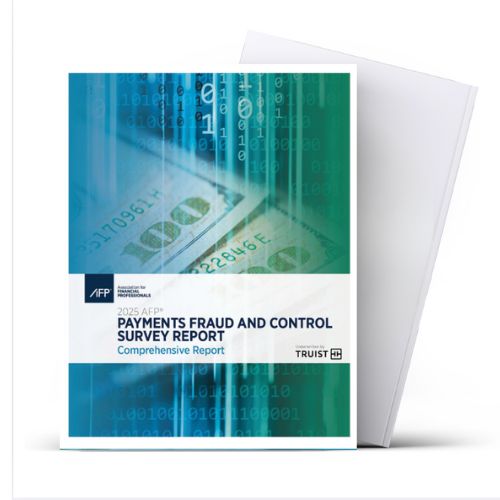
2025 AFP Payments Fraud and Control Survey Report
Payments fraud remains one of the most persistent and costly risks facing organizations — and the 2025 AFP® Payments Fraud and Control Survey confirms that the threat continues to escalate.
Based on insights from more than 500 treasury practitioners, the study found that 79% of organizations experienced payments fraud attacks or attempts in 2024. Now in its 21st year, the survey provides a critical view into how fraud tactics are evolving, which payment methods are most exposed, and where organizations are succeeding — or struggling — to recover losses.
The data reinforces a sobering reality: while awareness of fraud risk is widespread, the methods used by attackers are shifting faster than many internal controls.
In This Report You Will Learn About:
-
Business Email Compromise (BEC) remains the top fraud threat, cited by 63% of organizations as the leading avenue for fraud attempts.
-
Checks continue to be the most frequently targeted payment method, with 63% of organizations reporting check fraud in 2024.
-
Wire transfers once again became the most vulnerable channel for BEC, surpassing ACH credits.
-
Fraud tactics are evolving:
-
Executive impersonation declined to 49%
-
Vendor impersonation increased to 60%
-
Third-party impersonation remains the most common at 63%
-
-
Recovery outcomes weakened:
-
Only 22% of organizations recovered 75% or more of lost funds in 2024 (down from 41% in 2023)
-
However, 58% recovered up to 75% of losses, up from 29% the prior year
-
Why It Matters
As payment channels diversify and fraud schemes grow more sophisticated, organizations must rethink how they design controls, train teams, and prioritize risk investments. This research provides a practical, data-driven foundation for strengthening fraud prevention strategies and improving financial resilience.
Access
This report is complimentary for AFP members.
Non-members may access the Key Highlights through this Intel summary.
This research is provided by our partners.
Access Research
More Research
Completed Research
Advisory 360 Research Study Report
Does advisory work truly drive firm success? The Advisory 360 study by the Center for Accounting Transformation and CPA Trendlines explores whether advisory or compliance models perform better—and how specialization shapes outcomes.
Completed Research
The Cost of Losing Talent: Why Belonging is Essential for Firm Resilience & Growth
The 2025 Accounting MOVE Project highlights a critical moment as talent shortages, declining CPA pursuit, and leadership retirements converge. The study calls for clarity and action, showing how culture and opportunity shape who enters, stays, and advances.
Completed Research
Staffing Strategies Research Study Report
Accounting faces ongoing staffing shortages, but what’s actually working? A six-month study by the Center for Accounting Transformation and CPA Trendlines uncovers key challenges and highlights strategies firms are using—and underusing—to address workforce gaps.
External Research
2024 CPA Firm Tech Report
In this study, CPA Crossings partnered with five industry subject matter experts to identify the most common challenges to implementing and leveraging technology—and how to overcome them.
Active Research
Staffing Strategies Research
What staffing strategies are actually working in accounting today? Ongoing research from the Center for Accounting Transformation and CPA Trendlines reveals data-driven approaches helping firms navigate the talent crisis. Explore the insights.
Completed Research
2025 AFP Payments Fraud and Control Survey Report
Payments fraud is rising, with 79% of organizations targeted in 2024. Insights from 500+ treasury professionals show threats evolving faster than controls, exposing gaps in prevention and recovery—and reinforcing the need for stronger, more adaptive defenses.
Completed Research
Remote Work Practices and Cybersecurity Risk Research Report
Remote and hybrid work are now standard, offering flexibility but increasing cybersecurity risks. Research by the Center for Accounting Transformation highlights the need for stronger awareness and proactive controls to balance modern work practices with resilient, effective security.