
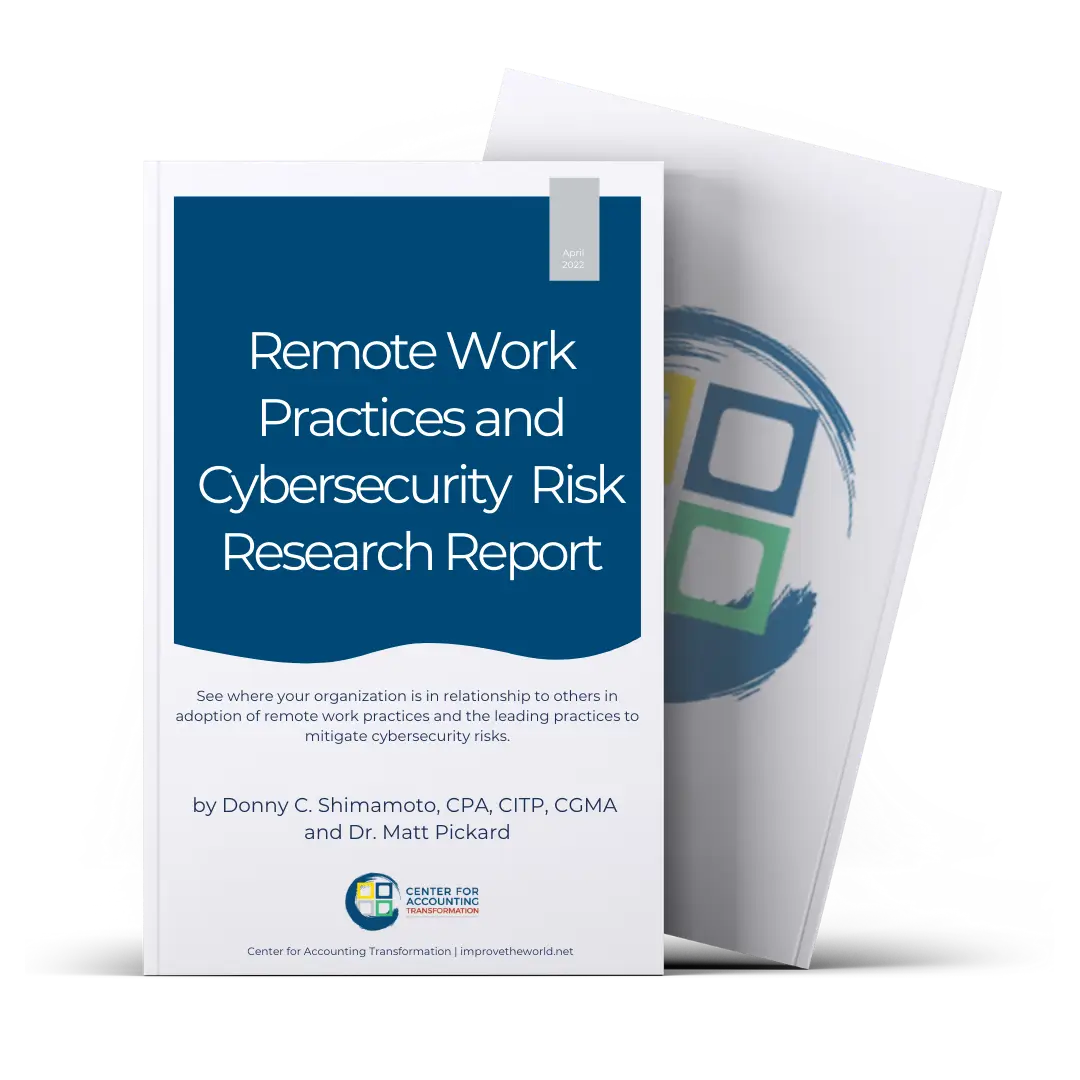
Remote Work Practices and Cybersecurity Risk Research Report

Image

Published: April 2022

Remote work practices and the leading practices to mitigate cybersecurity risks

Remote and hybrid work have become a standard part of how organizations operate, supported by an expanding set of digital tools and distributed workflows. While these models offer flexibility and efficiency, they also introduce new considerations around data security and risk management.

At the same time, cybersecurity threats continue to evolve, prompting insurers, regulators, and stakeholders to expect stronger, more proactive controls. Organizations are increasingly being asked to demonstrate not only awareness of these risks, but also the steps they are taking to address them.

In a recent survey conducted by the Center for Accounting Transformation, our analysis highlighted a need for greater awareness of cybersecurity risks and a clearer understanding of the controls required to mitigate them. The findings reinforce the importance of thoughtfully balancing the advantages of flexible work environments with the responsibility to maintain strong, resilient security practices.

In This Report You Will Learn About:

  • Risk Aversion and Trust
  • Risk Tolerance versus Cybersecurity Controls
  • Remote Work Devices and Security
  • Securing the Home Network
  • Additional Cybersecurity Controls
  • Recommendations

Access the report to see where your organization falls in relationship to others in adoption of remote work practices and the leading practices to mitigate cybersecurity risks.
Remote Work Practices and Cybersecurity Risk Research Report, mockup
Name
This field is hidden when viewing the form

More Research

Completed Research

The DEI Journey of the Accounting Profession Research Report

DEI remains an ongoing challenge, extending beyond policies and metrics to true belonging. This research highlights the need for a holistic approach, offering firms actionable insights to build more inclusive cultures and strengthen the future of the profession.

Completed Research

Advisory 360 Research Study Report

Does advisory work truly drive firm success? The Advisory 360 study by the Center for Accounting Transformation and CPA Trendlines explores whether advisory or compliance models perform better—and how specialization shapes outcomes.

Completed Research

2025 AFP Payments Fraud and Control Survey Report

Payments fraud is rising, with 79% of organizations targeted in 2024. Insights from 500+ treasury professionals show threats evolving faster than controls, exposing gaps in prevention and recovery—and reinforcing the need for stronger, more adaptive defenses.

Active Research

Staffing Strategies Research

What staffing strategies are actually working in accounting today? Ongoing research from the Center for Accounting Transformation and CPA Trendlines reveals data-driven approaches helping firms navigate the talent crisis. Explore the insights.

External Research

Re-Decoding the Decline

A national survey by the Illinois Society of CPAs of 7,780 students and young professionals reveals what’s driving CPA career decisions. The 2024 report uncovers key perceptions, challenges, and deterrents shaping the pipeline—offering critical insights the profession can’t ignore.

External Research

The Cost of Losing Talent

The 2025 Accounting MOVE Project examines how evolving attitudes toward diversity, equity, and inclusion are influencing the accounting profession at a critical moment marked by severe talent shortages and leadership transitions. The report explores how workplace culture, belonging, and equitable advancement practices directly affect firms’ ability to attract, retain, and develop professionals. It highlights the strategic risks of disengagement, shares insights from participating firms, and reinforces inclusion as a practical business imperative essential to the profession’s long-term resilience, competitiveness, and growth.

Completed Research

IT Platforms Report

The IT Platforms Report delivers a data-driven look at how accounting firms are selecting, using, and optimizing their technology. It highlights adoption trends, firm-level differences, and practical insights to help benchmark and evolve tech strategies.

External Research

2024 CPA Firm Tech Report

In this study, CPA Crossings partnered with five industry subject matter experts to identify the most common challenges to implementing and leveraging technology—and how to overcome them.
Industry Voices

Regenerative Budgeting in Practice

In this Accounting Alchemy Network Social Forum, members gathered for an interactive, community-led conversation on Regenerative Budgeting Practices, hosted by Stacie Zastrow. The session explored why traditional annual budgets often create stress, rigidity, and “spend it or lose it” behaviors—and how organizations can shift toward budgeting approaches that are more adaptive, transparent, and aligned with living-systems thinking.

Stacie shared her real-world experience getting the greenlight to revisit her organization’s budgeting process, drawing inspiration from concepts like Beyond Budgeting, more frequent (quarterly) planning cycles, and decision-making models rooted in trust rather than control. Together, participants unpacked budgeting as a cultural practice—one shaped by scarcity mindsets, power dynamics, and inherited norms—and discussed what it can look like to treat budgeting as an ongoing conversation instead of a static annual document.

The forum also expanded the lens beyond financial capital, touching on multi-capital considerations like time, energy, human capacity, community impact, and long-term resilience. The result was a thoughtful, practical, and values-driven dialogue—rich with questions, examples, and next-step experiments—for anyone seeking a healthier relationship with money and accountability inside organizations.

Destination Workplace Roundtable

Accounting Meta Influencers examine what it truly takes for accounting firms to become places where people want to build long, meaningful careers. Drawing on research, polling, and candid discussion among industry leaders, this session focuses on why firms struggle with attraction and retention—and what must change to reverse the trend.

The conversation explores the profession’s pipeline challenges, including declining accounting degrees and CPA exam participation, and connects them directly to career design, compensation, and leadership practices. Panelists discuss the limitations of traditional partnership-only career paths and highlight alternative models such as lifetime senior roles, non-CPA tracks, and more transparent advancement options. Compensation, benefits, and flexibility emerge as critical levers, alongside the growing importance of hybrid and remote work arrangements.

Participants also examine how technology, DEI, and intentional management practices can improve engagement, reduce burnout, and address the “three-year exodus” many firms experience. From unlimited PTO and customized benefits to clearer communication and empathetic leadership, the discussion emphasizes practical strategies firms can adopt now.

This video offers a grounded, experience-driven look at how accounting firms can evolve into destination workplaces—by aligning career opportunity, culture, and leadership with the realities of today’s workforce—through the lens of the Accounting Meta Influencers community.

Firm Business Models Roundtable

Accounting Meta Influencers explore how accounting firms are rethinking their business models in response to mounting pressure from talent shortages, private equity, technology, and changing expectations around leadership and culture. This roundtable brings together industry leaders to examine what true business model transformation looks like beyond surface-level change.

The conversation centers on three interconnected areas: ownership and governance, management structure, and core business model design. Participants discuss the growing influence of mergers, acquisitions, and private equity; the rise of non-equity partners; and the structural tension between legacy partnership models and the needs of the next generation. Throughout the discussion, culture emerges as a critical factor—particularly the need to move away from scarcity and greed-driven decision-making toward generosity, alignment, and long-term sustainability.

Panelists also address the profession’s pipeline challenge, noting that fewer business students are choosing accounting and that firms must rethink compensation, career paths, and purpose to remain competitive. The role of AI and automation is explored not as a threat, but as a catalyst reshaping job roles and forcing firms to be more intentional about where human value truly lies.

This conversation offers a candid, forward-looking examination of how firms of all sizes—from micro firms to large, PE-backed organizations—can adapt their business models while staying true to their values. It’s a practical and thought-provoking conversation for firm leaders navigating succession planning, growth, and the future of the profession through the lens of Accounting Meta Influencers and research-driven insights connected to Avalara.

Firm Culture Roundtable

Meta Influencers brings together leaders from across the accounting profession to examine what it really takes to build, sustain, and evolve a healthy firm culture—especially during periods of transformation. Centered on a wide-ranging Meta Influencers roundtable, the conversation moves beyond abstract values to focus on the daily behaviors, systems, and leadership choices that shape culture in practice.

Participants explore themes of transparency, consistency, and credibility, with repeated emphasis on the idea that culture fails when stated values are not enforced or modeled. Drawing on real-world examples—most notably Aprio’s disciplined use of weekly behavioral “fundamentals”—the discussion highlights how intentional reinforcement, clear expectations, and accountability help culture endure across growth, hybrid work environments, and mergers.

The session also surfaces the diversity of cultures within the profession, contrasting profit-first models with values-driven firms that prioritize people, community, and long-term sustainability. Panelists discuss the role of leadership and HR in addressing misalignment, the importance of addressing unacceptable behavior quickly, and the use of surveys and feedback loops to measure whether culture is truly being lived—not just claimed.

This video offers candid insights for firm leaders navigating cultural complexity, generational shifts, and talent pressures, and underscores a shared conclusion: strong firm cultures are not accidental—they are defined, practiced, measured, and continuously refined.

Avalara Advisory Research Reactions

Avalara Advisory Research Reactions captures a dynamic roundtable discussion reacting to the latest findings from Avalara’s Meta Influencers Advisory research. Drawing on survey data from 177 accounting firms, the conversation explores what truly differentiates successful firms as they balance compliance and advisory work in an increasingly complex profession.

Participants unpack key insights from the research, including the role of technology as the top performance driver, the growing importance of firm culture and continuous learning, and the surprising finding that many high-performing firms succeed without strict specialization. The discussion also examines how deep compliance expertise often serves as the foundation for effective advisory services, and why intentional productization of advice is critical for long-term growth.

The roundtable dives into the realities of niching and specialization—when it matters, when it doesn’t, and how networks of specialists and generalists can work together to better serve clients. Panelists also address the accelerating impact of AI and automation on compliance work, the irreplaceable value of human judgment in complex cases, and the urgent need for better education and talent development within the profession.

This session offers thoughtful, experience-driven perspectives on the future of accounting advisory, helping firm leaders rethink strategy, specialization, and sustainable growth in a rapidly evolving landscape.

Fostering Healthy Teams & Culture KPIs

Hosted by the Accounting Alchemy Network (AAN), this Community Social Forum brings members together for an honest, wide-ranging conversation about what “healthy culture” really means—and how we might actually measure it. With spotlight guests, the gathering explores the intersection of humane workplaces, leadership behaviors, and practical data: what should we be paying attention to, what signals matter, and how can accounting professionals help organizations make better culture decisions with more than just gut feel?

The discussion opens with AAN’s grounding practice—an intentional reminder that culture is human first—then moves into community introductions and a shared “peek behind the curtain” at themes emerging from AAN’s ongoing Humane Workspaces conversations. From there, the group digs into values-in-action (not “values on a wall”), agreements and consent in workplace relationships, belonging and retention, flexibility and accountability, and the real-world tension between “we’re a team” and the realities of power dynamics, standards, and scale. Along the way, participants surface lived examples—from values embedded in job postings to PTO practices and coaching cultures—and return repeatedly to a central question: if culture is the operating system of a firm, what KPIs can we use to know whether it’s healthy, inclusive, and working?

Dimension of Possible: Developing a Conscious Leader Mindset

In this Accounting Alchemy Network Lyceum, Ingrid Edstrom is joined by Sarah Elliot and Brian Cush of Intend to Lead for a reflective and energizing conversation about leadership, mindset, and what they call the “Dimension of Possible.” The session explores how accounting professionals can move beyond scarcity-driven, fear-based ways of working and step into more conscious, human-centered leadership.

Drawing on their experiences as CPAs turned executive leadership coaches, Sarah and Brian share how coaching transformed their own careers and why mindset—not just skillset—is the key to healthier cultures, stronger teams, and more sustainable firms. The conversation looks at the shift from command-and-control leadership to coaching-oriented leadership, where curiosity, collaboration, vulnerability, and purpose replace certainty, competition, and burnout.

Throughout the discussion, the group connects these ideas to the realities of the accounting profession today—burnout, talent challenges, and outdated expectations—and offers a hopeful reframe: meaningful change starts with self-awareness, personal wellbeing, and leaders who model a different way of showing up. This episode invites listeners to rethink what leadership looks like in accounting and to imagine what becomes possible when we lead from abundance, care, and intention rather than fear and scarcity.

Lyceum Conversation: Can ESG Help Balance Business Decisions in a Post Growth World?

In this Accounting Alchemy Network (AAN) Lyceum, co-founders Matthew Heggem and Ingrid Edstrom host an “experiment in dialogue”—bringing together two thought leaders from different worlds to explore a big, timely question: Can ESG help us navigate toward a post-growth economy, and what would that require from the accounting profession?

This session features Donny Shimamoto, CPA, CGMA, CITP, an innovation and integrated risk management leader focused on how organizations make decisions—and Donnie Maclurkin, Executive Director of the Post Growth Institute and an economics professor whose work centers on money flows, debt, and what comes after growth-dependent capitalism. Together, they unpack the fundamentals of ESG (Environmental, Social, and Governance) and define what a post-growth world means: an economy designed for wellbeing and resilience within ecological limits, rather than perpetual expansion.

Throughout the conversation, the group digs into how today’s system is shaped by debt, speculative valuation, and externalities—and how those forces drive many of the challenges ESG is attempting to address. Audience questions deepen the discussion, including how intellectual property, market speculation, and shifting consumer expectations affect organizations, and why “genuine” ESG matters more than performative reporting.

A central theme emerges: accountants are not just record-keepers—they are influencers, standard-setters, and protectors of integrity. The speakers explore why the profession is uniquely positioned to expand what we measure, how we measure it, and how that information guides decisions—from global corporations to small businesses. The session closes with a call for continued learning, clearer frameworks, real-world examples, and follow-up conversations that make these complex ideas more practical and actionable.

This Lyceum is ideal for anyone curious about the future of accounting, the limits of growth-based economics, and how evolving measurement and accountability can help shape a healthier, more sustainable world.

Social Forum | The Justice, Equity, Diversity, & Inclusion (JEDI) Journey

Held on Thursday, December 14, 2023, this all-network forum brought members of the Accounting Alchemy Network (AAN) together to explore one of the most important and complex topics facing our profession—and our world today: Justice, Equity, Diversity, and Inclusion (JEDI).

This session follows the completion of AAN’s JEDI Training Pilot, a multi-week program designed to create brave, structured spaces for deep learning and dialogue around sensitive and often avoided topics, including race, white fragility and privilege, belonging, and how social conditioning shows up in our workplaces and professional culture. During the forum, participants from the pilot cohort share their lived experiences, key takeaways, and personal growth edges, while members who did not participate in the pilot are invited into the conversation with curiosity, questions, and reflection.

Grounded in intentional facilitation and a clear communications framework, the forum models how to create a psychologically safe “container” for conversations that can bring up strong emotions, discomfort, and insight—without judgment. Rather than positioning JEDI as compliance work or abstract theory, the discussion centers on capacity-building: developing the emotional awareness, empathy, and communication skills needed to foster real belonging and more effective, humane workplaces.

This video offers viewers an authentic look at what it means to engage in ongoing JEDI learning—not as a destination or checkbox, but as a continuous journey. It invites accounting professionals at every stage to step into deeper self-awareness, challenge inherited assumptions, and explore how justice-centered thinking strengthens leadership, culture, and the profession’s ability to serve a diverse and interconnected world.

Diversity, Equity & Inclusion in the Accounting Profession

Held on Friday, April 29, 2022, this second official Lyceum of the Accounting Alchemy Network (AAN) brings the profession into a candid, necessary conversation on Diversity, Equity, and Inclusion (DEI) as a foundational element of long-term transformation.

Moderated by AAN founders Ingrid Edstrom and Mathew Heggem, the Lyceum features special guest Jina Etienne, CPA, CGMA—one of the most influential diversity and inclusion leaders in the accounting profession. Drawing on more than three decades of experience across public accounting, professional associations, global firms, and executive leadership, Jina brings both deep expertise and lived experience to the discussion.

Together, the panel reframes DEI away from a compliance-driven “HR checkbox” and toward its true role as a strategic, cultural, and human imperative. The conversation explores why diversity, equity, inclusion, and belonging are distinct but interconnected concepts, why homogeneous leadership limits innovation and ethical decision-making, and how the profession’s long-standing monoculture constrains its ability to meet today’s complex global challenges.

Jina offers clear, practical definitions of diversity, inclusion, equity, and belonging—demystifying language that is often misunderstood or avoided—and challenges the profession to see DEI as a catalyst for better leadership, stronger teams, and more sustainable business outcomes. The Lyceum also addresses stereotypes within accounting, the hidden costs of exclusion, and why meaningful change requires inviting all voices—including majority leaders—into the conversation.

This session sets a critical foundation for the Accounting Alchemy Network’s broader mission: helping accounting professionals become a positive force in building a more regenerative, inclusive, and human-centered global economy.

Attracting Young People to Accounting

In this Accounting Alchemy Network (AAN) Social Forum, community members gathered for a candid, solutions-focused conversation on one of the profession’s most urgent challenges: how we attract—and keep—the next generation of accounting talent.

Guided by accounting thought leaders Donny Shimamoto and Dan Luthi, the discussion moves beyond surface-level “pipeline talk” to explore what’s actually shifting (and what’s often misunderstood). Donny brings a research-informed perspective—challenging common narratives with data and reframing the shortage conversation to look not only at entry-level roles, but also at mid-level experience gaps, the CPA focus, and what truly draws people into the profession. Dan shares a grounded, real-world view from firm life, including a compelling personal example of introducing his own kids to accounting through hands-on exposure, QuickBooks certification, and practical business applications.

Together, the group explores innovative, more engaging approaches to recruitment and professional identity—highlighting accounting as storytelling, judgment, systems thinking, and trusted advisory, not just tax forms, audit checklists, or data entry. The conversation also touches on the role technology can play in reducing the most draining work, freeing accountants to focus on higher-value, more purpose-driven contributions—like helping organizations make better decisions, build integrity into their numbers, and even expand accounting into emerging areas such as ESG and carbon measurement.

This forum is an energizing look at how the profession can evolve its message, its culture, and its pathways—so that young people see accounting not as a grind, but as a meaningful, creative, and impact-oriented career.

Worker Owned Coop Accounting Firm

In this wide-ranging and deeply human discussion, the Accounting Alchemy Network has a conversation with Ryan Knowles, founder of Knowles Solutions, who shares his firm’s ongoing journey toward becoming a worker-owned cooperative and what inspired him to step away from traditional accounting firm models. Drawing on his lived experience, values, and client work, Ryan explores how cooperative ownership can create more equitable, sustainable, and humane workplaces—without sacrificing professional rigor or quality.

The conversation also dives into Ryan’s niche serving social justice–focused nonprofits and mission-driven small businesses, and how working closely with these organizations has shaped his perspective on labor, value, and impact. Ryan speaks candidly about challenging the corporate status quo in accounting, rethinking growth and compensation expectations, and prioritizing balance, family, and community over extractive business models.

This video offers an honest, practical look at what it means to “act like” a worker-owned cooperative even before legal structures are finalized, touching on culture, decision-making, governance, and values in day-to-day practice. It’s an inspiring exploration for anyone curious about alternative ownership models, values-aligned careers, and the future of the accounting profession beyond profit-first thinking.